WABASH NATIONAL (WNC)·Q4 2025 Earnings Summary
Wabash Misses on EPS as Q1 Set to Be 'The Bottom' — Stock Drops 9% After Hours
February 4, 2026 · by Fintool AI Agent
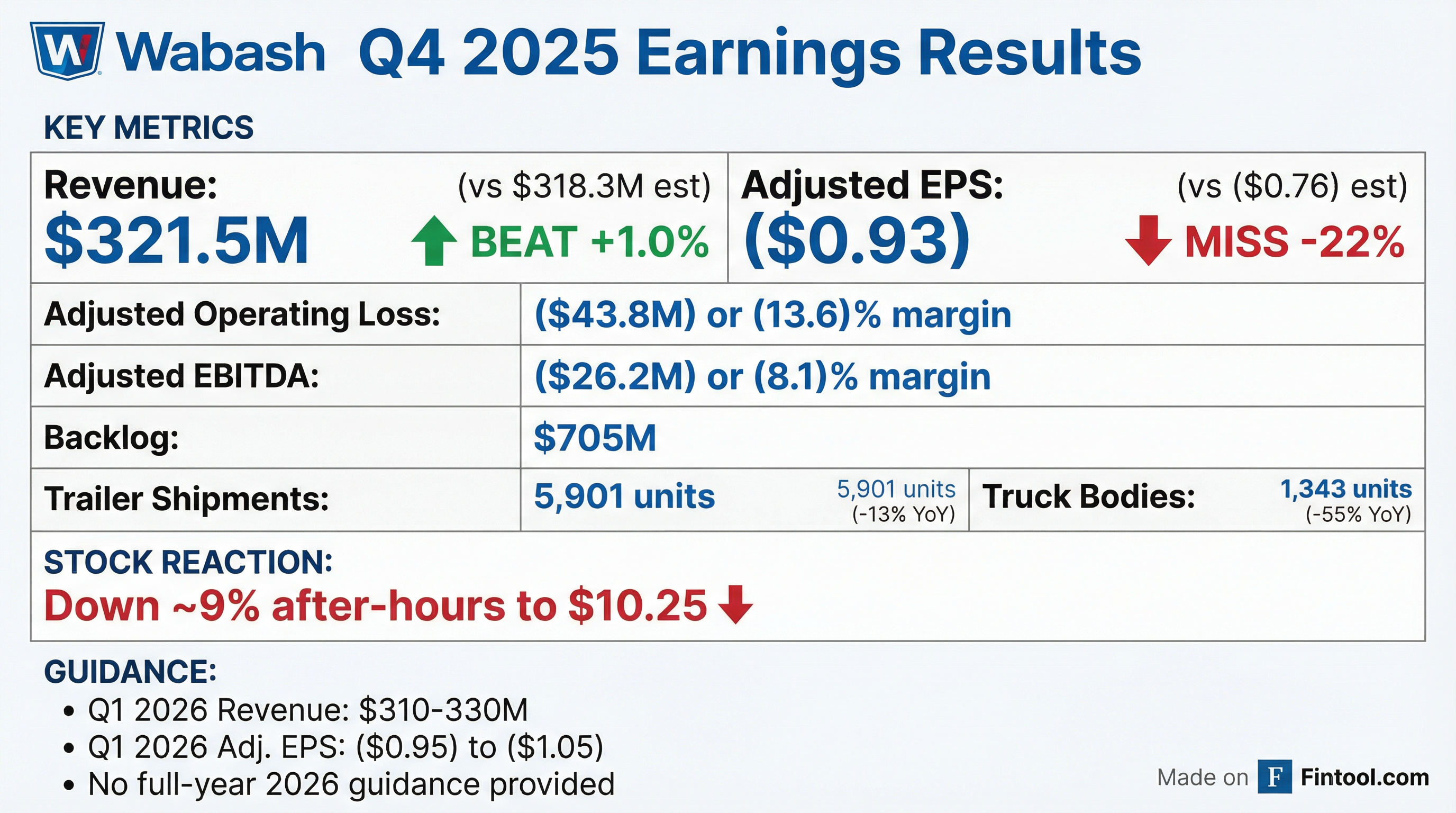
Wabash National (WNC) reported Q4 2025 results that beat revenue estimates by 1% but missed on EPS by 22%, sending shares down nearly 9% in after-hours trading. Management positioned Q1 2026 as "the bottom" for the year, with demand improvement expected in the second half and a stronger 2027.
Did Wabash Beat Earnings?
Revenue: Beat by 1.0% — Wabash reported Q4 revenue of $321M versus consensus of $318M.
Adjusted EPS: Missed by 22% — Adjusted diluted EPS came in at $(0.93), significantly worse than the $(0.76) consensus estimate. GAAP EPS was $(1.23), reflecting a $16.1M impairment charge related to idling the Little Falls, MN manufacturing facility.
The gross profit margin turned negative at (1.9%) as revenue declined 23% year-over-year while fixed costs remained elevated.
 Ask Fintool AI Agent
How Did the Stock React?
WNC closed the regular session at $11.24, up 3.1% on the day, as investors positioned ahead of results. However, the stock dropped sharply to $10.25 in after-hours trading — a decline of 8.8% from the close — as the EPS miss and weak near-term outlook weighed on sentiment.
The stock has been volatile over the past two years, dropping to under $7 following the Missouri product liability verdict in Q3 2024 before recovering after the verdict was reversed in Q1 2025.
What Did Management Guide?
Management provided Q1 2026 guidance that implies continued near-term pressure but characterized the quarter as "the bottom" for the year:
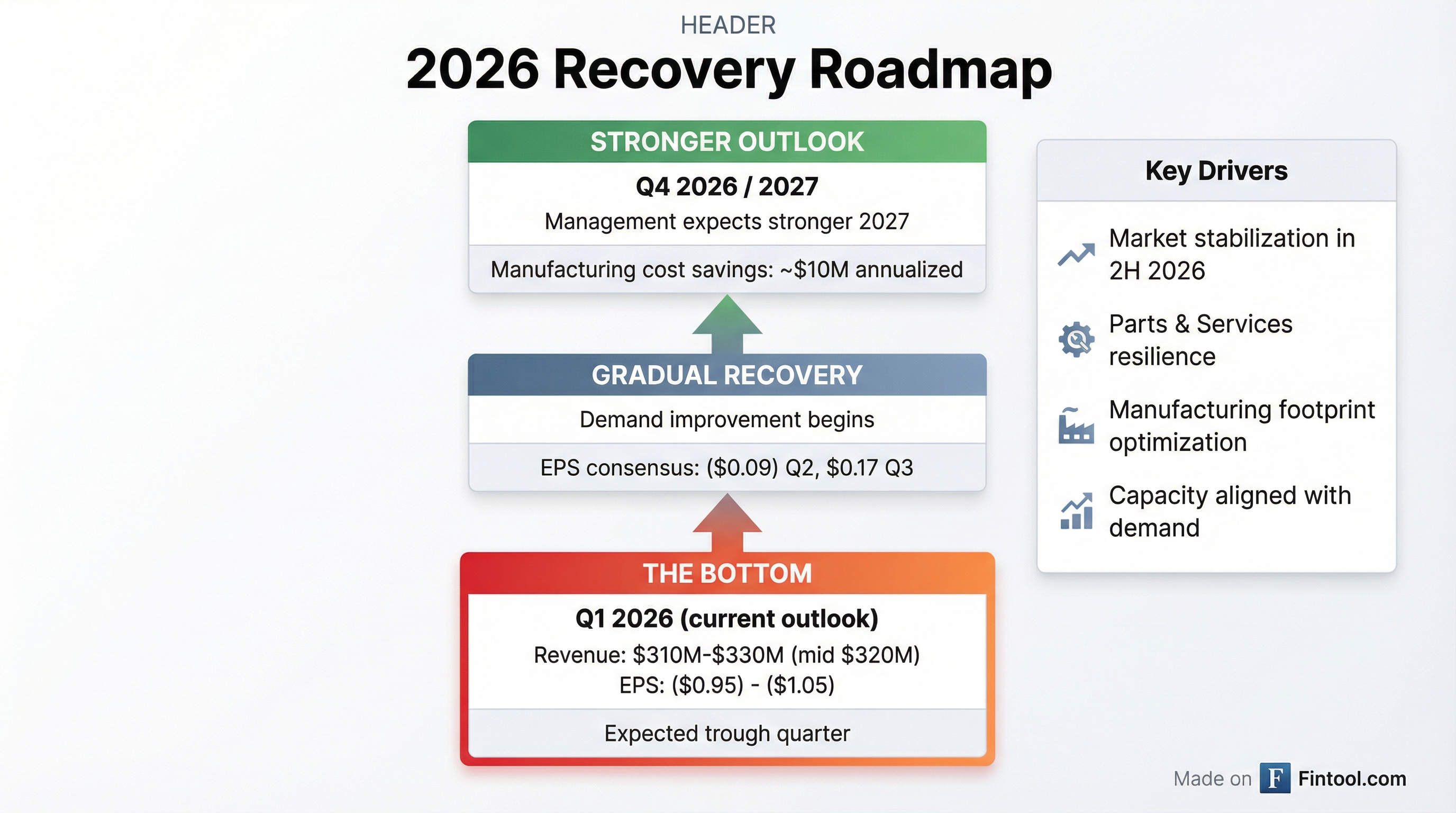
The midpoint revenue of $320M is essentially flat with Q4, while EPS at the midpoint of $(1.00) represents a slight sequential deterioration. Management emphasized that market conditions are "showing early signs of stabilization" with demand improvement expected in 2H 2026 and a "stronger 2027."
No full-year 2026 guidance was provided due to limited visibility into the timing and pace of freight market recovery. However, management stated they expect full-year 2026 revenue and operating margin to be higher than 2025, with the first quarter representing "the bottom."
A notable positive: customer engagement around 2026 purchasing decisions is ongoing, and many fleet order commitments for the year remain open and active — "a positive departure from historic norms for this period of the sales cycle for trailers."
What Changed From Last Quarter?
Transportation Solutions deteriorated significantly:
- Revenue fell to $263M from $370M in Q4 2024 (-29% YoY)
- Adjusted operating margin swung to (12.1%) from +4.8% a year ago
- Trailer shipments dropped to 5,901 units from 6,770 (-13% YoY)
- Truck body shipments collapsed to 1,343 from 3,010 (-55% YoY)
Parts & Services provided a bright spot:
- Revenue grew 33% year-over-year and 6% sequentially to $64.5M
- Adjusted operating margin of 7.9% remained solid
- Upfit business shipped ~550 units in Q4, bringing FY 2025 volume to ~2,050 units (>2x FY 2023)
- Three new upfit centers opened in 2H 2025: Northwest Indiana, Atlanta, Phoenix
"In the fourth quarter, the segment grew 33% year over year and approximately 6% sequentially, even as the broader OE market remains down more than 40% from the 2023 peak. Growth in this environment gives us confidence that what we're seeing here is structural, not cyclical." — Mike Pettit, Chief Growth Officer
Manufacturing footprint actions: Management idled the Little Falls, MN and Goshen, IN facilities, resulting in $16M of non-cash charges in Q4 with an additional $4M-$5M expected in 1H 2026 (mostly non-cash). These actions are expected to generate approximately $10M in annualized cost savings primarily from fixed manufacturing overhead and operating expenses.
Ask Fintool AI AgentCash Flow & Balance Sheet
Free cash flow was deeply negative at $(69.3)M in Q4, a sharp reversal from $54.0M in Q4 2024.
Capital allocation in Q4:
- Capex: $4.5M (29%)
- Revenue Generating Assets: $7.4M (47%)
- Share Repurchases: $0.7M (4%)
- Dividends: $3.2M (20%)
Balance sheet shows cash of $31.9M (down from $115.5M a year ago) and long-term debt of $442.9M.
Full Year 2025 vs 2024
For the full year, Wabash reported a GAAP net income of $211.5M driven by the Missouri legal matter reversal, versus a net loss of $(284.1)M in 2024 which included the $450M Missouri verdict charge.
Excluding the Missouri legal matter, adjusted FY 2025 EPS was $(2.15) compared to $1.22 in FY 2024 — reflecting the significant deterioration in core operations as the trailer and truck body markets contracted.
Risks & Concerns
Key risks flagged in the presentation:
- Missouri product liability action remains an ongoing risk despite the verdict reversal
- Highly cyclical business with uncertain economic conditions
- Customer demand uncertainty — backlog may not reflect future sales
- Tariff exposure — raw material shortages and costs including tariff impacts
- Labor costs and availability
- Customer pick-up delays
Forward Catalysts
Near-term (Q1-Q2 2026):
- Execute on $10M cost savings from manufacturing footprint optimization
- Continue Parts & Services momentum
- Navigate through "the bottom" quarter
Medium-term (2H 2026 - 2027):
- Market demand improvement expected in 2H 2026
- "Stronger 2027" per management outlook
- Analyst consensus shows EPS turning positive by Q3 2026 ($0.17 expected)*
*Values retrieved from S&P Global
Ask Fintool AI AgentQ&A Highlights
On the Little Falls and Goshen facility idlings:
Management clarified that Wabash is not exiting the refrigerated market. The Little Falls closure is a "timeout" to reposition the reefer product for a better cost structure heading into a 2027 market recovery. Refrigerated truck body capacity is retained across the network.
"We're taking a timeout to be able to let those things take place, which will ultimately put a better product on the road. It'll have a better cost structure, and the market will be more responsive when we do that." — Brent Yeagy, CEO
On Parts & Services outlook:
The Q4 revenue run rate (~$64M quarterly) is expected to continue into 2026. Margins were pressured by weak OE parts demand and upfit startup costs, but should improve after Q1. Long-term EBITDA margin target remains high teens.
Key upfit metrics disclosed:
- Q4 shipments: ~550 units
- FY 2025 volume: ~2,050 units (more than 2x FY 2023)
- 2026 target: >2,500 units
- New upfit centers opened in 2H 2025: Northwest Indiana, Atlanta, Phoenix
On market dynamics and timing:
CEO Yeagy offered notable optimism on the trajectory, while acknowledging the disconnect between improving fundamentals and near-term financials:
"The rate of change has been fairly significant in the last 90 to 120 days, which has piqued people's interests. If those can remain sustainable into the second half of the year... it absolutely can change the feeling of what is the forthcoming market, not to less bad, but to good."
"We're positioning Wabash, on one hand, to prepare for the reality of the moment, and on the other hand, absolutely preparing for a much better environment as we move into the second half of the year, getting ready for 2027."
On capital allocation:
- ABL has $45M drawn as of year-end — priority is to pay that down as cash becomes available
- Maintenance CapEx expected at ~$26M (similar to 2025)
- No near-term TaaS (revenue-generating asset) investments planned
- Dividend maintained; share repurchases opportunistic
On tariff impacts:
Management stated that direct material cost impact from tariffs is "pretty minimal." The margin pressure is primarily due to competitive pricing dynamics in a down market, not input costs.
Ask Fintool AI AgentAnti-Dumping & Trade Petitions
Wabash disclosed that the domestic trailer industry has filed antidumping and countervailing duty petitions with the U.S. Department of Commerce and the U.S. International Trade Commission concerning certain imported trailer products.
Timeline:
- February 6, 2026: ITC preliminary determination expected (may be delayed by government shutdown)
- 2H 2026 (~October): Commerce Department preliminary determinations, followed by final determinations
If the preliminary determination is affirmative on February 6, duties and penalty percentages will be announced. The physical collection of duties would follow the final determination later in the year. Wabash noted it would not incur any fees or costs related to this process — any penalties fall on the named international competitors.
This represents a potential tailwind for domestic trailer manufacturers if duties are imposed, though the investigation covers the 2022-2024 period and outcomes remain uncertain.
The Bottom Line
Wabash's Q4 results underscore the challenging environment for trailer and truck body manufacturers. While revenue slightly beat estimates, the EPS miss and continued losses through Q1 2026 weighed on sentiment. The investment case now hinges on management's conviction that Q1 represents "the bottom" and that demand will recover in the second half with a stronger 2027.
Parts & Services growth (+33% YoY) provides resilience, with management noting this growth is "structural, not cyclical." The upfit business more than doubled since 2023 and is targeting 2,500+ units in 2026.
Key catalysts to watch: the February 6 anti-dumping preliminary determination, signs of sustained freight market improvement in Q2, and whether customer order commitments — currently described as "a positive departure from historic norms" — translate to second-half orders.
With the stock down 9% after hours, the market is skeptical of the near-term path. But management's framework is clear: prepare for the reality of today while positioning for a much better 2027.